Your oven is the heartbeat of your kitchen. Whether you are baking holiday cookies, roasting a Sunday dinner, or just reheating leftovers, you rely on it to perform consistently. However, ovens are complex machines that endure extreme temperature fluctuations day after day. If you notice your kitchen centerpiece struggling to keep up, it might be time to look into Appliance Repair in Palm Bay, FL, before you’re left with a half-baked meal and a major headache. Recognizing the subtle signals that your unit is nearing the end of its rope can save you from a kitchen disaster.
It is easy to ignore small glitches when you’re busy, but ovens rarely fail without giving a warning first. Understanding these signs is the best way to avoid an expensive total replacement. Here is what you should look out for to keep your culinary workspace running smoothly.
Uneven Baking and Temperature Fluctuations
The most common sign of an oven in distress is inconsistent cooking. If your cookies are burnt on the edges but raw in the center, or if your roasts take significantly longer than the recipe calls for, your heating element or temperature sensor is likely failing.
- The Heating Element: If you notice the element isn’t glowing bright red (for electric ovens) or showing signs of blistering, it’s not producing heat efficiently.
- Temperature Sensors: This is the small probe inside your oven that tells the computer the current temperature. If this is faulty, your oven will struggle to calibrate properly, leading to wild temperature swings.
Strange Noises During Operation
Ovens are generally quiet appliances. While you might hear a faint hum or the click of the timer, you should never hear grinding, rattling, or loud metallic clanging. If your oven is making noise, it’s usually an issue with the convection fan motor or the heating assembly. Ignoring these sounds can lead to a complete motor burnout, which is a much more complex and costly fix than replacing a simple fan blade or bearing.
Extended Preheating Times
Do you feel like you have time to watch an entire show before your oven reaches 350°F? While some modern ovens take longer than others, a noticeable increase in preheating time compared to when the unit was new is a major red flag. This often indicates that the heating element is struggling to reach the desired temperature, meaning the internal components are working twice as hard for half the result.
If this happens, it is often a sign of aging components or a failing thermostat. In many cases, a simple calibration or part replacement can restore your oven’s efficiency.
Gas Odors: A Critical Safety Warning
If you use a gas oven, safety is paramount. If you smell gas at any time—especially when the oven is off—you must prioritize your safety immediately. However, if you detect a faint gas smell only when the oven is ignited, it could mean the pilot light isn’t lighting correctly, or there is a faulty valve or burner tube.
Do not attempt to DIY gas-related issues. This is a situation where professional intervention is absolutely necessary. Experienced technicians, such as those at RMJP Appliance Repair, have the specific tools to detect gas leaks and ensure your oven is safe for use.
Deteriorating Door Seals and Latches
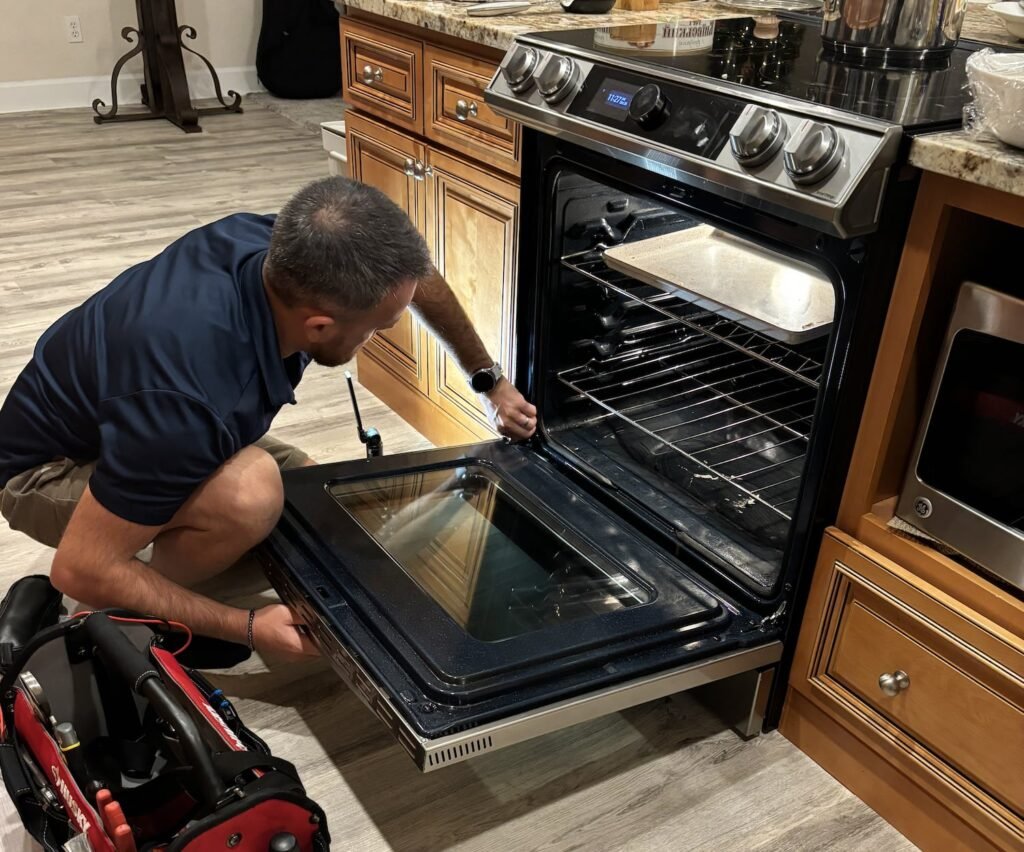
We often overlook the door, but it is one of the most critical parts of your oven. The rubber gasket (or door seal) is responsible for keeping the heat inside. If you see cracks, fraying, or gaps in the seal, heat will escape, forcing your oven to cycle on and off constantly to maintain the set temperature.
- The Check: Take a flashlight and inspect the seal while the door is closed. If you see light escaping, you are losing energy and cooking efficiency.
- The Latch: If the door latch is loose or fails to lock securely, it can cause the oven to lose heat or, in self-cleaning models, create a massive safety risk. Replacing a gasket is often an inexpensive fix that drastically improves performance.
Addressing Recurring Home Appliance Problems
Dealing with an underperforming oven is just one of many home appliance problems that homeowners in Florida face. Between the salt air affecting exterior casing and the high humidity impacting electrical components, your appliances are constantly under environmental stress. It is worth keeping an eye on your range, stovetop, and convection components as a single ecosystem. If your oven is acting up, check your stovetop too—often, the control board that manages both is the root cause of the issue.
When you start noticing these patterns, the best course of action is to avoid procrastination. A small fix today—like replacing a heating element or a gasket—prevents the chain reaction of damage that leads to total unit failure. Proper maintenance not only preserves the appliance but also keeps your monthly utility bills lower by ensuring the unit isn’t drawing unnecessary power to compensate for faults.
When to Call the Professionals
Sometimes, no matter how well you maintain your appliances, parts simply wear out. Whether it’s a fried control board, a faulty igniter, or a digital display that has gone blank, having a reliable partner in your corner is essential. Regular check-ups from experts like RMJP Appliance Repair can help you determine if your oven is worth saving or if it is finally time to upgrade to a newer, more energy-efficient model.
Don’t let a malfunctioning oven ruin your meal planning or pose a safety risk to your home. If you are experiencing any of these warning signs, it is time to get a professional opinion.